
Framework · framework · Leadership · Financial Tech
What changes when agents start doing the work
Asking a model a question is not the same as delegating a task. This framework uses one checkout support workflow to explain chat, collaborative, and autonomous modes, and who stays accountable in each.
3 min read · Updated 2026-06-26
Reader takeaway
- Chat vs collaborative vs autonomous on one checkout support workflow
- Who starts, who checks, and who stays accountable in each mode
- A stop condition to write before you reduce supervision
Answer versus delegated work
Chat gives you a draft. Delegated work has a trigger, an output someone will use, and a person who is accountable if it is wrong. Teams get into trouble when they treat the first as if it were the second.
Status: framework for choosing a mode. Not a case study of one team’s adoption with measured outcomes.
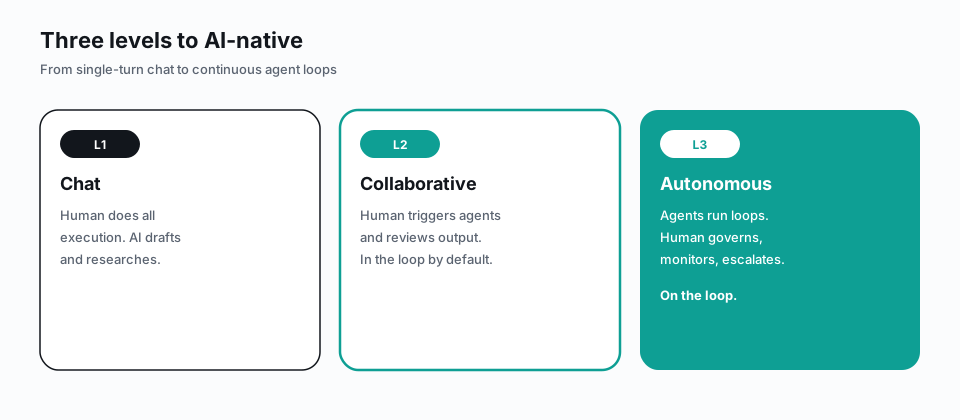
One workflow, three modes
Running example: support keeps filing tickets where Apple Pay fails after the user rotates their card. Someone has to diagnose, patch, and ship a fix.
| Mode | Who starts | What the agent does | What a human checks | Who is accountable |
|---|---|---|---|---|
| Chat | Engineer pastes logs into a model | Drafts hypotheses or a patch sketch | Everything: repro, code, merge, release | The engineer |
| Collaborative | Engineer triggers a written workflow (“fix Apple Pay after card update”) | Opens a branch, proposes a fix, attaches a preview link | Review of the PR and preview before merge | The engineer who merges |
| Autonomous | Ticket label or failing check starts the loop | Proposes or applies a fix inside policy | Exceptions, policy changes, production impact | The owner named on the workflow |
Not every workflow should move to autonomous mode. High blast radius belongs in chat or collaborative mode until the checks are boring.
In the work and on the loop
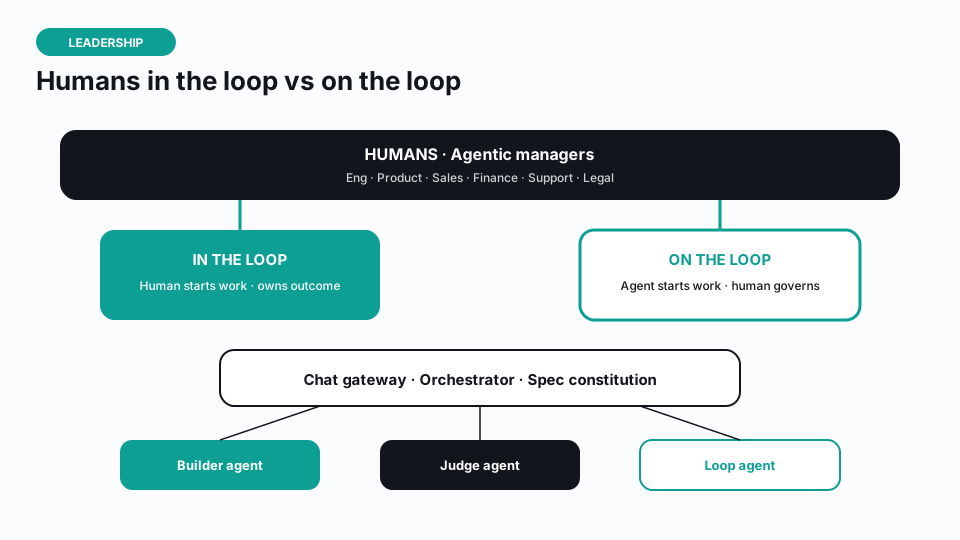
In the work means a person starts the thread and owns the outcome; agents speed drafting, coding, or checks. On the loop means an agent may start from a signal; the person reviews exceptions, sets policy, and can stop the loop.
For the Apple Pay example in collaborative mode, a practical stop condition is: if the preview still fails the card-update path twice, the agent stops and the human takes the ticket. Write that rule next to the workflow, not in a slide deck.
A first step
Choose one bounded workflow. Write who starts it, what the agent may do, what a human checks, who is accountable, and what stops the loop. Run it in collaborative mode before you consider autonomy. Keep the rest of the org out of the experiment until that loop is boring.