Leadership · Financial Tech
Scaling teams of people and agents
How a high-traffic Financial Tech product org moves from chat assistants to AI-native loops: humans as agentic managers, in the loop versus on the loop, and adversarial review.
12 min read · Updated 2026-06-26

The shift
Becoming AI-native is not “give everyone a chatbot.” It is a move from employees doing manual workflows to employees managing fleets of agents. Every role becomes an agentic manager. Architecture, process, and culture have to move together.
Success metrics belong to departments. If a metric is flat for two review cycles, the related loop gets redesigned or killed. That keeps the program from becoming slideware.
Three levels
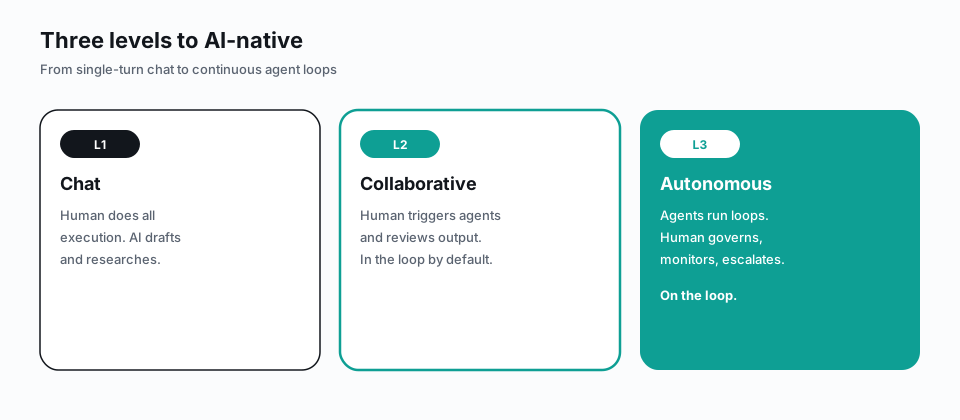
Level 1 is chat: generative, single-turn. Humans do all execution; AI drafts and researches. Level 2 is collaborative: agents sit in workflows. Humans trigger work and review output (pull requests with preview links, multi-step automations). Level 3 is autonomous: continuous loops. Agents initiate work; humans govern, monitor, and escalate.
Most teams sit at Level 1. The hard jump is Level 1 to Level 2. Once workflows are codified and connected, Level 3 is infrastructure, not imagination.
In the loop vs on the loop
In the loop: a human initiates the work and owns the outcome. Agents accelerate drafting, coding, or checks, but the human starts the thread. On the loop: an agent initiates from a signal (pipeline health, deploy monitor, daily digest). The human reviews exceptions, sets policy, and can stop the loop.
Both modes need a gateway people already use (chat on mobile and desktop), an orchestrator that routes and rewrites, and a version-controlled constitution: master prompt, specs, and skills that encode “how we ship here.”
Judges and role change
Builder agents write from specs. Judge agents run adversarial review on different models than the producer, with weighted consensus. Loop agents watch blind spots on a schedule. Nothing sensitive leaves staging without a human gate.
Engineers shift from writing every line to writing specs, maintaining scaffolding, reviewing agent PRs, and debugging context. QA designs strategies for AI-generated change. Non-engineers propose; engineers still own the production bar. The point is leverage with guardrails, not replacing judgment.